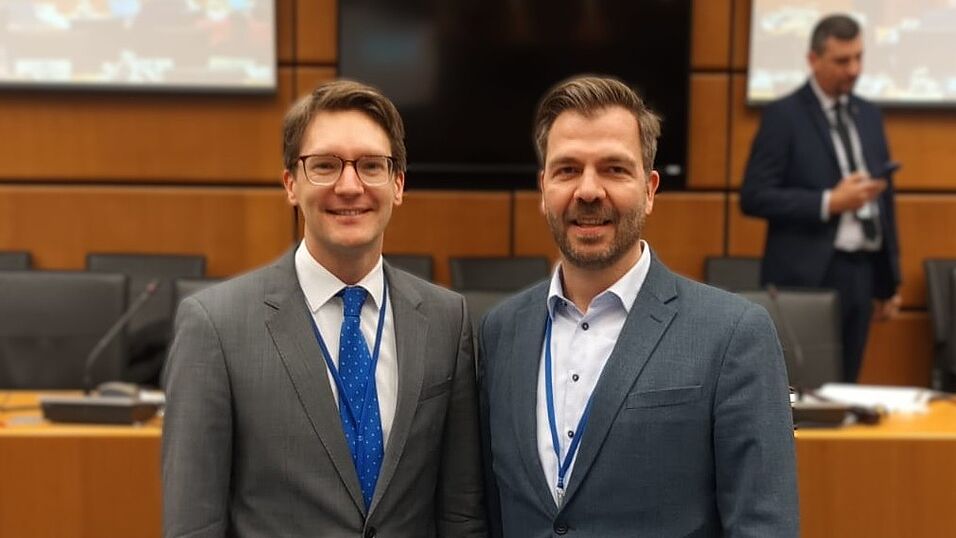
The ELI was represented by Prof Dr Stephan Madaus (University of Halle-Wittenberg, Germany) and Dr Gert-Jan Boon (Leiden University, Leiden), Co-Reporter and project team member, respectively, of the ELI project on Rescue of Business in Insolvency Law.
The session was devoted to the project on applicable law in insolvency proceedings. The current text provides for draft model law provisions with an accompanying guide to enactment, providing a further commentary. This draft legislation contains a list of the body of insolvency law rules that are meant to form the lex fori concursus. Similar to the European Insolvency Regulation (EIR 2015), the general rule on the governing law is supplemented by a number of exceptions. In the current draft there is a limited number of exceptions and/or special rules related to clearing and settlement systems; close-out netting; pending litigations and arbitration proceedings; security rights, and avoidance actions. A short chapter adds a rule that gives effect to the UNCITRAL framework in the context of recognition and cross-border cooperation.
The Working Group has spent a significant amount of time discussing the text and is currently focussing on a small number of provisions and explanations in the commentary that have remained controversial. Most prominently, the ability of the lex fori concursus of a (main) insolvency proceedings to stay or amend the security interest in collateral abroad is a topic of intense debate. While some delegations strongly supported the application of the lex fori concursus, others insisted to disagree. The proposed approach provides a rule that allows the lex fori concursus to affect such security rights abroad, unless the affected creditor is substantially worse of compared to an enforcement of their rights in the jurisdiction where the assets are located. Drawing on discussions at a previous session, the Working Group explored in more detail how such an approach can take shape. From an EU perspective, such a compromise would be a welcomed approach for a tentative reform of Article 8 EIR 2015 in the near future.
Further discussions related to the law applicable to the effects of an insolvency proceeding on pending lawsuits or pending arbitration. Different alternatives were discussed including the application of the lex fori arbitri, the general staying of any proceedings, or facilitating that the pending litigation or arbitration may be taken into account if the insolvency representative has been able to be sufficiently heard and participate in the proceedings.
The Working Group’s meeting was followed by a two-day colloquium which discussed future work of the Working Group, most notably possible amendments to the Guide to Enactment and Interpretation to the UNCITRAL Model Law on Cross-Border Insolvency.